
Water Leaks
Water Leaks at Home:
Have you received an unusually high water bill? Or do you want to be sure your home is as water efficient as possible? According to the Environmental Protection Agency, over one year, a typical household leak can waste enough water to do 315 loads of laundry. That's an extra 20 percent on your water bill. Use the tips and resources below to identify and stop leaks in your home.
Who is responsible for what?
You are responsible for maintaining the water meter and pipes inside your home to your property line.
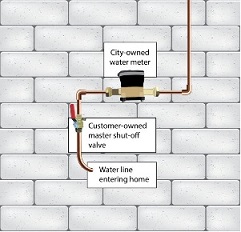
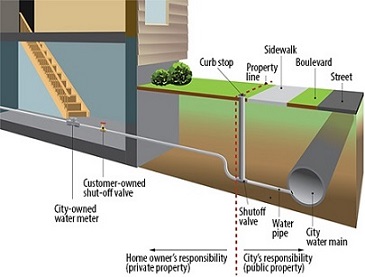
Inside the House Outside the House
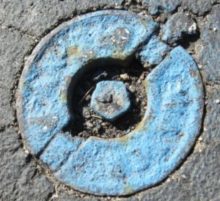
Usually, the curb stop is located at the property line. The curb stop is a control valve for the water supply to your home. It acts to shut off the water in case of an emergency.
You are responsible for repairs to any privately owned pipes that are leaking, including the pipe between the property line and the water meter. In addition, you are responsible for paying for all water that passes through your water meter, including water leaks or plumbing malfunctions.
How to detect a household leak and what to do when you find it:
Step 1: Use your water meter to detect leaks
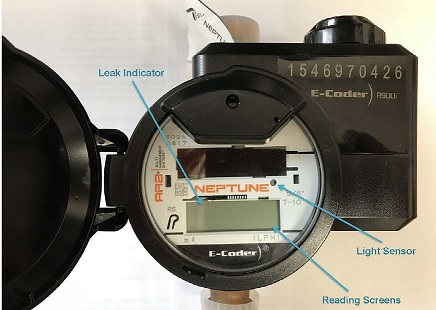
Locate your water meter. Typically, your property's water meter is located in the basement or crawl space. Water meters are usually where the water pipe enters your home.
Hold a bright flashlight on the light sensor (Described as "Light Sensor" below photo).
The LCD will display intermittent display screens:
- Meter reading to the nearest thousandth (3 decimal places)
- Rate of flow
To check for a water leak, examine the rate of flow display:
- Shut off all water in the house.
- Activate the meter using a flashlight.
- Observe the rate of the flow display screen.
- An observed rate reading greater than 0.000 corresponds to water moving through the meter. If all water has been shut-off, a leak may exist in your water system at some point between your water meter and your faucets and other water fixtures.
Another way to detect leaks is by using the leak indicator display on your meter. The leak indicator displays a possible leak with a dripping faucet icon in the upper left corner of the LCD panel.
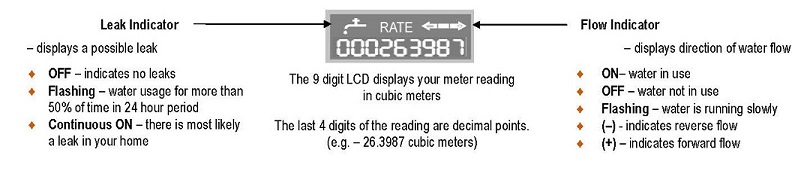
Contact a licensed plumber to identify and remedy the problem immediately to avoid excessive billing.
Step 2: Find the leak and repair it.
The top causes of water leaks and high water bills are:
- toilet leaks
- irrigation system leaks
- sink and faucet leaks
- swimming pool leaks
- water softeners that are not working properly
Other sources of water leaks include:
- hot water tank
- furnace-mounted humidifier valves
- water-primed floor drain
- washing machine
- sprinkler system
- outdoor hose bib
Resources
Myth #1: Small Leaks Don't Add Up
Myth #2: Leaks are Seen and Heard
Myth #4: Water Meters Can Over Record
Important Note:
The homeowner is responsible for all necessary plumbing repairs and maintenance inside their home. The Town is not responsible for internal plumbing leaks in a private residence. If you cannot locate the source of a leak or perform the necessary repairs, please get in touch with a qualified plumbing professional.
Cost of Leaks:
If you have a water leak, water use will increase and remain elevated until it is fixed, affecting your water consumption charges and resulting in a higher utility bill.
Water Service Pipe Leak:
A continuous leak from a hole in a water service pipe can waste water in the amounts shown below:
Chart of Water Leak Costs
| Size of Hole | Amount and Cost of Water Wasted |
|---|---|
| 1/16" hole |
Wastes 3.57 m³ (3,570 litres) in 24 hours Cost: $17.54/day or $2,104.80 in 120 days |
| 1/8" hole |
Wastes 14 m³ (14,000 litres) in 24 hours Cost: $68.77/day or $8,252.40 in 120 days |
| 3/16" hole |
Wastes 32.13 m³ (32,130 litres in 24 hours Cost: $157.82/day or $18,938.40 in 120 days |
Toilet Leak:
A leaky toilet can waste up to 600+ cubic metres a month or 20 cubic metres a day:
Chart of Toilet Leak Costs
| Amount of Wasted Water | Cost of Wasted Water |
|---|---|
| 20 m³ (20,000 litres) | $66.94/day |
| 600 m³ (600,000 litres) | $2,947.20/month |
If you have questions or concerns, call the Operations Division at (905) 871-1600 x2466
Contact Us
Town of Fort Erie
1 Municipal Centre Drive,
Fort Erie, ON, L2A 2S6
Phone: 905-871-1600
Send an Email
Sign up to our Newsletter
Sign up to receive information from the Town of Fort Erie directly to your inbox. Check out the various categories of general news, and emergency notifications.


